
“We Bury the Dead” is an atmospheric slow burn of a zombie movie, which some will accept with relief, while others instantly dismiss it while they line up for “28 Years Later: The Bone Temple.”
This new horror film, written and directed by Zak Hilditch, set in Tasmania and depicting a landscape of corpses suddenly showing life and aggression, isn’t quite the stinker the first week-of-January release date would lead one to believe.
It’s not scary enough for October and not exciting enough for summer, but it’s good enough to see at least once. The film is better than most of the dismal new fare that studios typically dump in theaters this time of year.

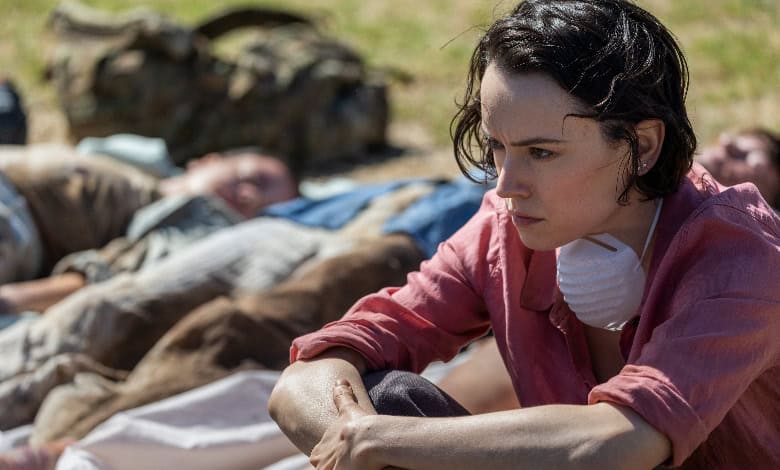
Daisy Ridley plays a grieving chiropractor who enters the zombified landscape in hopes of reconnecting with her missing husband. She meets a real wild card (Brenton Thwaites of “The Giver”) who helps her survive the dangerous terrain but can’t talk her out of pressing on into unpredictable landscapes with no safety in sight.
By giving this a Conrad-inspired “Heart of Darkness”/”Apocalypse Now” feel, of a journey in which the traveler is immersing herself into total madness, the story takes its time and lingers on the environment. Since the film is so gorgeously shot and full of striking vistas worth seeing on the big screen, the decision to be a slow-moving movie about slow-moving zombies mostly works.
Yet, the film exists in a world where no one has heard of zombies or seen a George A. Romero movie. What is awfully familiar to the viewer is new to the onscreen characters, creating monotony, as well as a murky threat: sometimes the zombies run but mostly they walk, and they don’t seem to be cannibals or much more than a nuisance.
So how are they a threat, aside from messily dropping pieces of themselves on the ground?
“We Bury the Dead” only seems partially invested in the zombies and more interested in using the horror genre to paint a metaphor for how we deal with loss. One of the best scenes involves a human helping a zombie bury his deceased family. The whole film is like that, emphasizing how humans deal with loss and mourning, with intermittent zombie sightings.
There are a few good jolts, the zombie make-up is excellent, and I cared about the protagonist, mostly due to how affecting Ridley is in the role. This is a far better vehicle for her than last January’s stink bomb, “Cleaner.”
A pivotal sequence, set in a farmhouse and reflecting on the loss of a marriage partner, is good at character building but it slows the whole movie down. Despite a fairly brisk running time, “We Bury the Dead” isn’t as quick on its feet as it ought to be.
A sequence where Ridley’s character must walk 40 miles on foot while carrying an axe isn’t just implausible- the movie is so laid back, you wonder if we’re going to watch her do it in real time (spoiler: we don’t).
“We Bury the Dead” reminded me of the equally impressive but not entirely memorable “It Comes at Night” (2017). The best version of this type of zombie subgenre (call is the Touchy Feely Zombie Movie) is “Maggie” (2015), the terrific, devastating zombie drama.

A farmer (Arnold Schwarzenegger, never better) discovers that his daughter (Abigail Breslin, who’s excellent) has been bitten by a zombie and has hours before she turns, but he refuses to give up on her. “Maggie” used the zombie scenario as a metaphor for being a parent with a dying child and the film hits hard.
“We Bury the Dead” should be more impactful, but it has some odd tonal changes, like a heart-to-heart confession suddenly interrupted by a rowdy pool party. The few moments of comic relief are welcome but, likewise, out of place for a film so downbeat.
A character tells Ridley to “use The Force,” a shoutout this doesn’t earn or need. “We Bury the Dead” is good enough to see once, but zombie fans will seek something meatier to chew on.
Two and a half stars (out of four)