
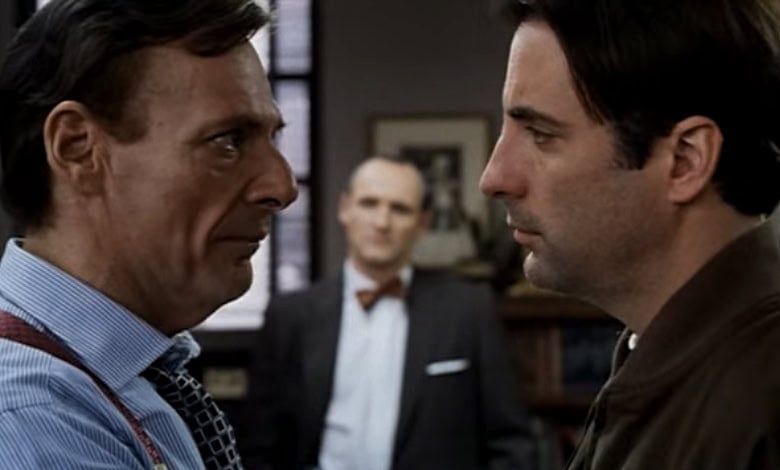
In Sidney Lumet’s “Night Falls on Manhattan” (1996), Andy Garcia stars as Sean Casey, a newly appointed New York district attorney.
Casey is handed a sensational case to prosecute a vicious drug dealer named Jordan Washington (Shiek Mahmud-Bey, in an intense performance), who killed three cops during a failed bust. Despite Casey going up against attorney Sam Vigoda (Richard Dreyfuss, in one of his best performances), it seems like an open and shut case with a career making win for Casey.
On the surface and in the media, it appears that justice has won but the more intricate details of the case tell a different story.

I first encountered “Night Falls on Manhattan” during my summer job as a movie theater usher, where the film randomly appeared during the summer of 1997. The drama opened alongside heavyweights such as “The Fifth Element” and “Breakdown.”
Why on Earth did anyone at Paramount Pictures think that this film, which had a real shot at Oscar and awards consideration in the fall, would have caught on at the height of popcorn movie season?
When cinephiles go over the list of Lumet’s finest work, “Network” (1976), “Serpico” (1973), “The Verdict” (1982), “Dog Day Afternoon” (1975) and “12 Angry Men” (1957) are always and deservedly near the top of any Best-Of list.
In terms of Lumet’s most underrated, I’d put “Night Falls on Manhattan” right next to his “Running on Empty” (1988), “Deathtrap” (1982) and “Equus” (1977). Of course, it’s easy to miss some gems in a body of work that touted no less than 43 films!
Lumet has made a few films that start strong but can’t stick the landing, as his “Prince of the City” (1981) and especially “Family Business” (1989) all fumble their third act. Here, the prologue and the courtroom case that takes up much of the second act are so sensational, the rest of the film is serviceable but lacks the punch of what came before it.
Nevertheless, the performances and scenes that hit hardest make it essential for fans of Lumet’s work.
#Film89ShotOfTheDay
No.2306
Night Falls on Manhattan (1996)
Director: Sidney Lumet
Cinematographer: David Watkin pic.twitter.com/CDQ911WKyy— The Film ’89 Podcast™️ (@Film89UK) March 3, 2024
Ron Leibman, the 1993 Tony Award winner for playing Roy Cohn in “Angels in America” on Broadway, steals his every scene as Casey’s mentor and career advisor. If any performance here should have been an Oscar lock, it’s Leibman’s.
Watch him closely during his final scene, where the camera captures a final look that could have been maudlin but, in Leibman’s hands, is a master class in underplaying. Leibman is electric and all the courtroom scenes crackle.
Casey is presented as an optimist and, during his big speech, declares “the law must apply to everyone.” The role should have been assigned to an actor younger than Garcia, who was 40 when the film was released;
Garcia is exceptional in this but he’s a decade too old for a character often described as too young and inexperienced. Had Garcia made this right after “The Untouchables” (1987), it could have worked. Despite the miscasting, which I forgave by the end of the second act, some of Garcia’s finest moments as an actor are here.
A harder pill to swallow is Ian Holm as a NYC cop – it’s a reach, but the actor mostly pulls it off. In addition to Garcia, this also showcases some of the best work ever from James Gandolfini (three years before “The Sopranos”) and Dreyfuss (who followed his surprise hit of “Mr. Holland’s Opus” with this).
While Lumet doesn’t let this become an action movie, the establishing incident and tragic aftermath are riveting (I loved the touch of Washington throwing bills at potential witnesses as he runs past them).
Lumet’s screenplay, based on Robert Daley’s novel “Tainted Evidence,” lacks a fuller third act, as the story comes full circle, and the themes are wrapped up but the ending still feels abrupt.
FAST FACT: Sidney Lumet worked as a child actor in Yiddish theater, his first brush with the performing arts.
I appreciate the trim 113-minute running time but can’t help but wonder if there used to be a lot more here. It feels like a sprawling epic that was edited down to a more reasonable length (perhaps in an attempt to avoid the bloat of the similarly themed but 167-minute-long “Prince of the City”).
Although it comes up a little short in the end and the love interest subplot (featuring Lena Olin) is unnecessary, the best scenes are powerful. Did this really need a love story? No, though Garcia and Olin make their scenes work.
Where the story gors overall isn’t terribly surprising, but it’s still a searing work with a message on the nature of corruption that hasn’t dated in the slightest.
While not on the level of “Network” or “The Verdict,” his untouchable masterpieces, this is among Lumet’s best during his final years.
Remember, Lumet’s directing career began with “12 Angry Men,” concluded with “Before the Devil Knows You’re Dead” (2007) and has hidden gems like “Nights Falls on Manhattan” in between, truly an extraordinary body of work from a legendary filmmaker.
The people on this website blow my mind with the film/literature raw genius so many possess. I am talking about the readers here. Don’t get me going on Chris and Barry and any other writer I may slight through not mentioning. The staff are walking encyclopedias. I am a simple minded movie lover but have neither the mental acuity nor the time to research films like the writers, editors and readers themselves. I am grateful to have this site bookmarked and have received many hidden screen gems I was unaware of just from haunting here. I remember this site from years ago (over a decade) and am pleased to see how much more sophisticated it has become.
You skipped over one of Lumet’s unheralded gems Q&A. Such strong work from one of films masters. He has a resume that many directors would gladly trade with their works.