
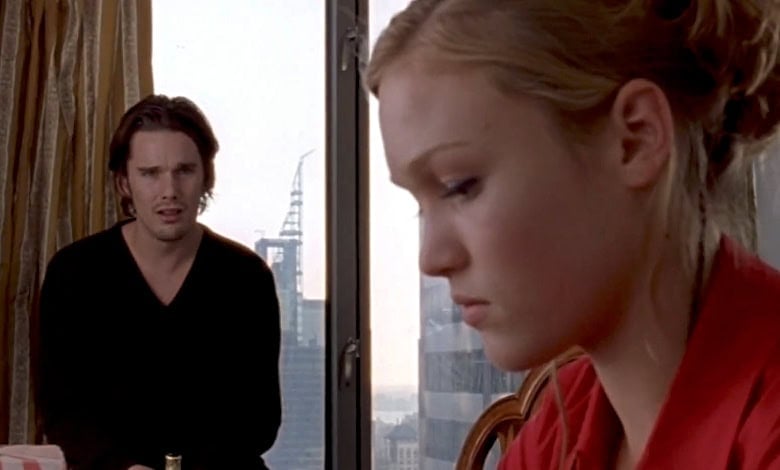
Concept Shakespeare, in which plays by William Shakespeare are made contemporary or presented in stylized, potentially more accessible ways, are nothing new to theater, though it’s an unusual quality for motion pictures.
There are a few examples of motion pictures that tackled William Shakespeare’s work in an unorthodox, novel or gimmicky manner.
Jean-Luc Godard’s bonkers 1987 “King Lear” is barely interested in the source material, offers none other than Woody Allen, Molly Ringwald, Burgess Meredith and Godard himself giving half-invested performances and plays like a private joke that only made Godard laugh.

Far more mainstream, if unique for its time, was Baz Luhrman’s “William Shakespeare’s Romeo + Juliet” (1996), in which Shakespeare’s character and dialog are interspersed with a modern setting and a kaleidoscopic, hyper-stylized MTV approach.
When it comes to “Hamlet,” arguably Shakespeare’s masterpiece and most performed work, most filmmakers either stick faithfully to the original text or use the narrative blueprint as a means to unfaithfully update the material and lose its beautiful language.
What Michael Almereyda’s 2000 film version of “Hamlet” has to offer is not a definitive interpretation of Shakespeare’s play. In fact, this is far from the most ideal, faithful version of the Bard’s two-act drama and is best viewed by those familiar with the story.

Newcomers may find the film perplexing and frustrating. For everyone else, particularly those familiar with “poor Yorick,” Rosencrantz and Guildenstern and infinitely quotable dialog like “The Play’s The Thing, Where Upon I’ll Catch the Conscience of the King,” this is something refreshing.
Opening in “New York City, 2000,” this “Hamlet” maintains the iambic pentameter (meaning, Shakespearean dialog) but is set in the last year of the 20th century. Taking place at “Hotel Elsinore” and portraying the events at “Denmark Corporation,” the tale of the Danish Prince is now an American yarn of businessmen who, literally, get blood on their hands.
Ethan Hawke plays Hamlet, now a tortured young amateur filmmaker whose wealthy mother Gertrude (Diane Venora) has re-married after the death of her husband (Sam Shepard). The Ghost of Hamlet’s father appears and informs his son that he was murdered by his wife’s new husband (Kyle MacLachlan).
Hamlet plots his revenge, dragging his secret love, Ophelia (Julia Stiles), down with him.
The cast is excellent. While this is Concept Shakespeare, no one is playing it that way, as everyone here is giving sincere, dedicated turns. Hawke is perfect, bringing his youthful, Gen-X teen angst to his portrayal.
Stiles is stronger than I expected as Ophelia and Liev Schrieber is first-rate as her brother, Laertes. Shepard is ideally cast and so is Steve Zahn, playing Rosencrantz as a barfly slacker.
Michael Almereyda’s HAMLET (2000) Starring Ethan Hawke, Julia Stiles, Sam Shepard, Kyle MacLachlan, Diane Venora, Bill Murray, and so many others.
Now playing on @criterionchannl in our Pop Shakespeare collection! https://t.co/vQzGa3zdVo pic.twitter.com/cHeoykl6Wu
— Criterion Collection (@Criterion) July 9, 2024
The biggest surprise is Bill Murray as Polonius: Murray isn’t a natural with Shakespearean prose and it shows. Instead, his self-styled performance, in which he plays the role as a bureaucratic suck-up, feels like Murray is adapting the language to his familiar persona.
It’s odd at first but fascinating to watch. Murray makes the role his own, even capping the “Look to it, I charge you” soliloquy by tying his daughter’s shoe.
There are other weird, post-modernist touches that bear mentioning. Hamlet gives his “To Be or Not To Be” speech while walking through the aisles of Blockbuster Video. As he broods from aisle to aisle, “The Crow: City of Angels” plays in the background.
The famous soliloquy has frequently been interpreted as a question of suicidal contemplation, something Hawke literalizes by opening the speech with a gun to his temple.
The Ghost of Hamlet’s Father vanishes into a Pepsi vending machine and, in a brilliant touch, “The Mouse Trap,” the play-within-the-play about Hamlet’s stepfather, is now a cheeky film-within-the-film.
Almereyda has made an experimental, weird but purposeful re-imagining. It has similarly deconstructive goals as Godard’s “King Lear” but maintains a clarity of theme and a fidelity to the source.
This low-budget and truncated yet still effective “Hamlet” is full of beauty and arrestingly different choices. Almereyda’s style is subtle, but he manages to find gorgeous imagery in unlikely places.
The one misstep is the climactic sword fight, which is now a rooftop sword match. It makes no sense having Hamlet brandish a gun but take on his opponent in a classical duel. While well-acted, this sequence is a dud and is the only one that could have used another unorthodox rethinking.
The artistic value of this “Hamlet” is that it’s distinctly Warhol-like, a reflection and dissection of established ideas and iconography of the source material, not a mere reproduction. Like a Warhol painting of an instantly recognizable individual, this begins with the expected, takes it apart and finds new ideas and a fresh staging of a durable, essential work of theater.
Kenneth Branagh’s three-hour, word-for-word 1996 adaptation, Laurence Olivier’s classic interpretation from 1948 or even Franco Zeffirelli’s exciting but questionable 1990 Mel Gibson version (where scenes were added) are better examples of faithful stage-to-screen adaptations that maintain the essence of the story.
Only Almereyda’s “Hamlet” offers the odd but one-of-a-kind pleasure of hearing Murray declare, “This Above All Else: To Thyself Be True.”