
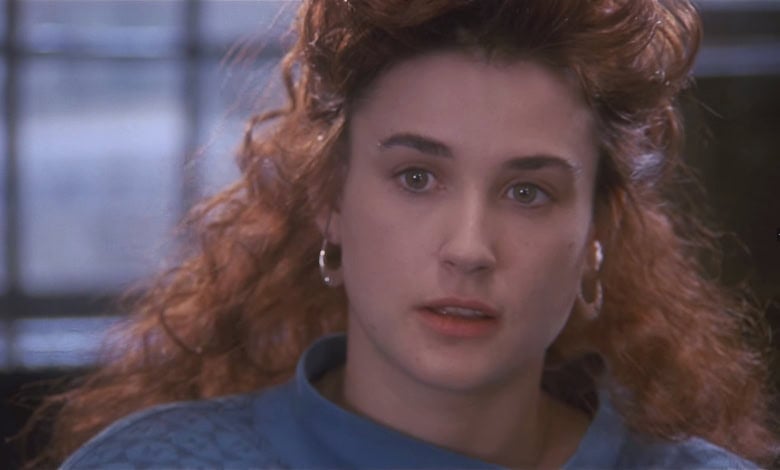
Alan Rudolph’s “Mortal Thoughts” (1991) is an interesting starring vehicle for Demi Moore, her first project where she was calling the shots as star and producer.
Rather than capitalize on having previously appeared in a blockbuster and following it up in a safe genre, she chose this, one of the darkest mainstream thrillers of its decade.
Rudolph’s thriller isn’t perfect and suffers from being over-directed (more on that later), but as a modern-day film noir and a showcase for some excellent performances, it’s worth rediscovering.

Rudolph’s New Jersey-set thriller stars Moore and Glenne Headley as Cynthia and Joyce, two best friends who share the same problem – Joyce’s husband, Jimmy (Bruce Willis) is an abusive, drug addicted, self-destructive monster. Introduced in a flashback on their wedding day, we see how Joyce is uneasy before her wedding, as Jimmy initially appears suave but quickly comes unglued and bulldozes anyone in his way.
The threat of violence always follows him.
Cynthia tolerates Jimmy but struggles to keep him from touching her. When the three of them take a trip to a carnival, one of them is murdered. A flashback structure, featuring Harvey Keitel as an interrogating cop (just a month before he played a nearly identical character in “Thelma & Louise”), has the suspects in the hot seat and presenting inconsistent recollections of the events before and after the killing took place.
FAST FACT: In a 2012 interview with Roger Ebert, Moore shared why she made “Mortal Thoughts” and her take on its box office potential: “I got a lot of support from my agent. We never set out to sell tremendous amounts of tickets; it wasn’t that kind of movie.”
Rudolph’s haunting thriller is told with too heavy a hand but is powered by vivid performances. The score by Mark Isham and the over-use of slow motion are too much, as Rudolph doesn’t need to announce the film noir tones, nor the darkness of the material.
We get it.
Moore, in her first big post-“Ghost” (1990) role, is excellent in a breakout character turn. It’s unlike anything she’s done before or since. Likewise, the wonderful Headley is superb and dedicated to a character who is frustrating but sympathetic.
Willis is phenomenal, devoted to someone who is irredeemable and cruel in plain sight. The character is ugly, and Willis has rarely been better. In later years, Willis often cited this performance as his best, and he’s probably right.
This is an anti-love story about how adults deal poorly with a couple who never should have gotten married in the first place.

“Mortal Thoughts” is refreshingly devoid of false uplift or even hope, as this pessimistic story suggests that murder was inevitable and the only way out when you’re stuck with someone as unhinged as Jimmy. These characters are doomed.
The suspense comes from how normal people have to suddenly cover up a murder that was premeditated. The screenplay by William Reilly and Claude Kerven captures the mania of being a normal, rational person who is sloppily trying to cover up a homicide and still fulfill and juggle the daily routine of daily life.
Rudolph has made better films, specifically his terrific, original 2003 comedy, “The Secret Lives of Dentists,” but “Mortal Thoughts” was a rare Hollywood outing for him, a chance to explore dark themes and present the story in his trademark stylized manner. Only here, the style isn’t entirely necessary, as the actors and tone convey the moralistic thriller tone better than the music or more overtly cinematic touches.
Watching Moore and Willis play scenes here that would be difficult for any pair of actors, let alone a married couple who were, at the time, among the most famous celebrities on Earth. There’s a bravery in these performances, which are frank and sharp, and elevate the entire film.
Every time I revisit “Mortal Thoughts,” I’m grateful for another shot at witnessing these superb performances. For Willis, it was a milestone in a career full of highlights and underrated turns.
This is an undiscovered gem from Moore and Willis that their fans owe themselves a watch.