
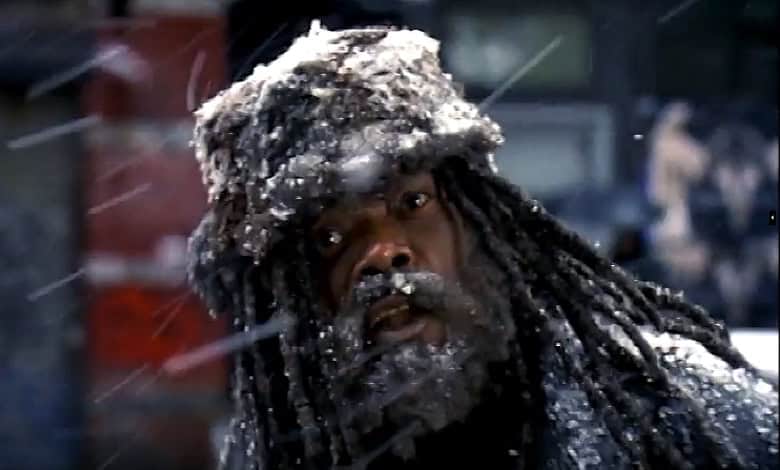
Kasi Lemmons’ “The Caveman’s Valentine” (2001) stars Samuel L. Jackson as a homeless man in New York named Romulus Ledbetter, a former Julliard pianist whose schizophrenia destroyed his once promising career.

Romulus maintains his intellect and ability to play the piano beautifully, but he’s also prone to outbursts, particularly towards the Chrysler Building, where he believes a man named Stuyvesant is blasting invisible rays at the population. There’s more – Romulus lives in a cave and explains to anyone who will listen that he has moth-like creatures living in his head.
When Romulus discovers a dead body, he has a big clue to share with the authorities, but no credibility with law enforcement.
So he takes on the case himself.
Lemmon’s film, her second after the acclaimed “Eve’s Bayou” (1997), which also starred Jackson, is tough, bold and in dire need of rediscovery. I saw it in the theater, was spellbound by the experience, then puzzled how it faded into obscurity.
As of this writing, the film has reappeared as an option on Prime Video, where I hope adventurous filmgoers will find it and give it a look.
The screenplay is by George Dawes Green, based on his 1994 debut novel; having the novelist who concocted the tale also acting as screenwriter is a mixed blessing.
FAST FACT: Lemmons created a short film in college, “Fall from Grace,” that found her interviewing homeless people on the streets. That experience helped her say yes to the script for “Caveman’s Valentine.”
On the plus side, the story’s untamed wildness is intact, as are the visionary touches. Nevertheless, some aspects that were easy to accept on the written page, and can be interpreted as magical realism, are harder to buy when made literal.
I’m not referring to the most magical moments but the basic concept, which is flawed: Romulus is out of his mind but his state of consciousness ranges from madly bonkers to a keen sense of observation that matches Sherlock Holmes.
Romulus is a heartbreaking character, especially during the moments when he loses control of his temper in public. We can’t help but root for him and hope he’ll either heal or, at the very least, be able to pull himself together.
Yet, when outbreaks of madness are followed by scenes where he possesses Columbo’s crime fighting skills, it suggests an ability to control his demons in the story’s second act that contradicts the first.
I was always rooting for Jackson’s character, even as the story greatly stretches credibility by the third act. In fact, (minor spoiler) the upbeat conclusion is nice, but I would prefer something more credible.
RELATED: WHY JACKSON’S ‘UNFORGETTABLE’ WAS SO RADICAL
Terry Gilliam’s thematically similar “The Fisher King” (1991), which lacks a mystery plot but also centers on a schizophrenic homeless man (played by Robin Williams, in a magnificent performance) is as wild as Lemmons’ film but is better at balancing the fantastical with the hard “reality” of the narrative.
Nevertheless, Jackson is amazing in this, somehow making Romulus intimidating and painfully vulnerable in equal measures. This is my favorite of Jackson’s performances and easily one of his most underappreciated. Despite my problems with the story’s credibility, Jackson makes Romulus the riveting center.
Ann Magnuson, Anthony Michael Hall and Colm Feore also stand out, as does Tamara Tunie, wonderful as a figure from Romulus’ past who constantly checks in on him.
At the midpoint, Romulus confronts Lulu, his daughter (Aunjanue Ellis-Taylor) and the two share a drive and find common ground for the first time. This sequence is so powerful, thinking about it reduces me to tears.
The best parts of “The Caveman’s Valentine” have that kind of power.
“The Caveman’s Valentine” is a strange but often dazzling film, with an outstanding Terrence Blanchard score (the end credits suite is a joy to revisit). The scenes taking place in Romulus’ mind, particularly the moments where we see the seraphs (moth-like creatures with human bodies) buzzing around, are stunning.
Lemmons’ film was produced by Danny DeVito’s Jersey Films and Elie Samaha’s Franchise Films, the latter company that released Sean Penn’s “The Pledge” the same year.

That film, starring Jack Nicholson, is also about a crime fighter with a broken mind struggling to solve a mystery while facing his inner demons. I love both of those movies, but watching them as a double feature is too much.
Despite the imperfections, this is my favorite film from Lemmons and, for the many cinephiles who never miss a film from Jackson, this is a milestone performance.