
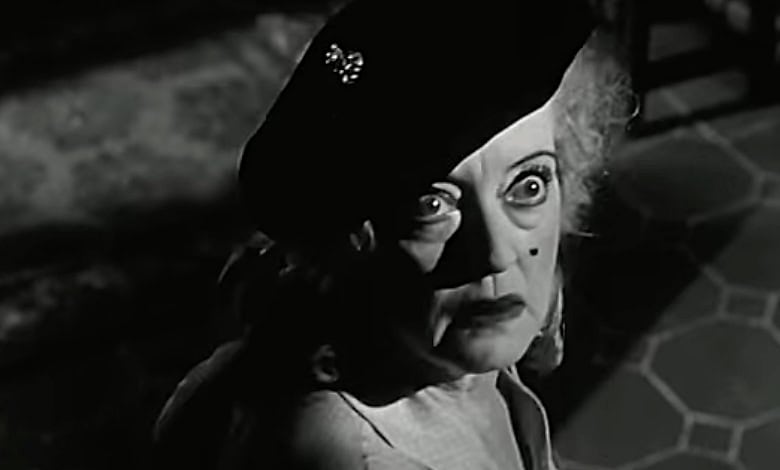
Robert Aldrich’s “Whatever Happened to Baby Jane?” (1962) somehow remains in the zeitgeist, both as a reference to a certain kind of horror movie and as an example of a film with a notorious production history.
I’ll get into both issues in a moment, but the most important takeaway is that the film itself, which is often cited as a “camp classic,” is so much better and stronger than most remember.

When we meet “Baby Jane” Hudson, she’s a hard-working but insufferable child actress (think Shirley Temple but with a visibly outsized ego), working the vaudeville theater circuit with her father in 1917. As Baby Jane does her song and dance to an adoring audience, her older sister Blanche watches with dismay.
A backstage encounter with fans reveals just how rotten Baby Jane is when she’s not performing, while Blanche is comparably reserved but unloved by their father. When Baby Jane and Blanche grow up, the former falls out of fashion with pop culture and the entertainment industry, while Blanche’s star rises when her Hollywood films make her an acclaimed actress.
The real story begins when we see, in 1962, Blanche (Joan Crawford) is confined to a wheelchair and being taken care of Baby Jane (Bette Davis), who thirsts for the popularity of her early life and has a raging bitterness within.
To put it mildly, she might be the worst person imaginable left to care for her sister. Both in childhood and later in life, Baby Jane must perform, must stay in the spotlight and must be loved.
“Whatever Happened to Baby Jane?” is still potent and captivating, though it contains a crucial flaw: this is an overlong, redundant two and a half hours that could and should have been edited down into a terrific 90-minutes (100, tops).
There are too many scenes of characters shuffling around, repeating themselves, which lets too much of the tension loose.
Arguably the most famous, unforgettable moment is when Baby Jane serves her sister an unwanted and unforgivable “meal,” a bit the screenplay unwisely repeats during the second act to diminished effect.

The vaudeville opener is excellent, providing a thematic connection to “Sunset Boulevard” (1950) and “Singin’ in the Rain” (1952). It illustrates how the toll of being a lifelong performer, who begins at childhood, will eventually become a great burden when the system that provided money and support turns against you.
Ernest Haller’s black and white cinematography is apropos of the characters’ origins in show business.
Aldrich, the filmmaker behind “Kiss Me Deadly” (1955) and “The Dirty Dozen” (1967), made the film for less than one million dollars, on a six-week schedule.
The film opened as the Cuban Missile Crisis ended, was promoted like “Psycho” (1960), and emerged as one of the biggest hits of the year.
So much of Aldrich’s film clearly inspired Stephen King’s “Misery” (both the 1987 novel and the 1990 Rob Reiner film), which also depicted a wheelchair-bound prisoner stuck in a house with a caretaker who isn’t merely dangerous but has stunted development.
The film’s finale, which takes place on a crowded beach, couldn’t be more perfect.
Baby Jane is the villain, of course, but she’s also a spoiled brat former kid superstar (remember, she has a line of dolls made in her likeness!) who was destined to stay rotten by an upbringing and handlers that needed her to be “on” and nothing more.
Even when the film starts to drag, a chilling Davis and an excellent Crawford keep this enthralling. The performances by Davis and Crawford aren’t “over the top” (as some critics dismissively claim) and fit the tone of the film and their tortured sisters.
The subsequent decades have milked the rumor mill dry of a battle between the two leads. One of the more amusing of these rumors has Crawford campaigning against Davis’s Oscar nomination.
Between the books, TV movies, E True Hollywood Stories and the 2017 Ryan Murphy mini-series (to name just a few that keep the supposed scandal alive), there’s always the term “alleged,” as most involved with the production insist that the “battle” between the two actresses was wildly exaggerated.
FAST FACT: The American Film Institute named Baby Jane one of the 100 greatest villains, coming in at no. 44.
What cannot be denied is that Davis was a clever choice for Baby Jane, as she was, in fact, the top box office star of 1939, just behind Shirley Temple. On the other hand, many noted that Davis receiving an Oscar nomination for her performance in this, while Crawford wasn’t nominated, seemed like Baby Jane’s ultimate revenge.
“Whatever Happened to Baby Jane?” led to subsequent genre vehicles for its two stars, as well as many thriller vehicles for older actors.
There’s nothing “campy” about this bitter, wild cautionary tale on raising a child solely to be the source of profit. Whether you believe David and Crawford were at one another’s throats during production or, more likely, they let their own bitter feelings toward their profession to guide their characterizations, they’re both riveting and really go for it.
Yes, the pathos in the characters reflects the real-life legacies of these screen legends, but Davis and Crawford also give tremendous performances that rank high among their best work.
I truly love the ending beach scene. Baby Jane asking–“You mean we could have been friends?” Or to that effect. It’s a great comment on wasted lives.