
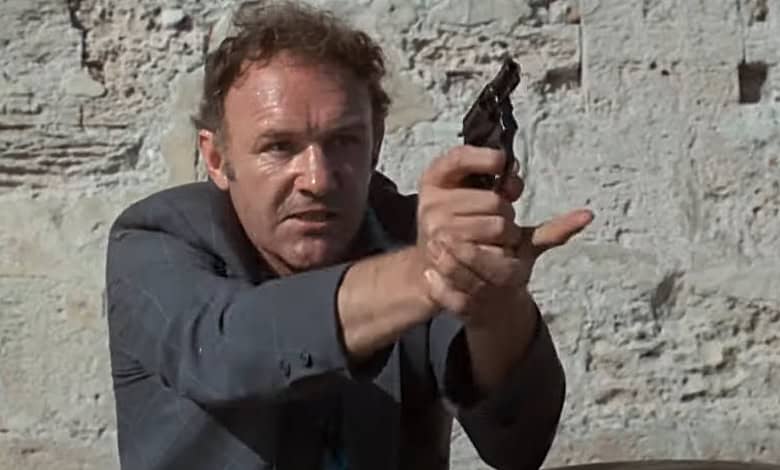
John Frankenheimer’s “French Connection II” (1975) had the impossible task of following a massively popular thriller that forever changed the police procedural genre.
William Friedkin’s “The French Connection” (1971) wasn’t just a substantial hit. It walked away with Best Picture honors at the Oscars and solidified its star, Gene Hackman, as one of the most reliable, effortlessly authentic and hardest working actors.
Making a sequel without Friedkin seemed foolish and potentially disastrous. What Frankenheimer, Hackman and the screenwriters (Alexander Jacobs and Robert and Laurie Dillon) pulled off with the second chapter is a minor movie miracle.

Four years have passed since the events of the first film. New York City cop Popeye Doyle (Hackman) is still infuriated by having failed to capture Alain Charnier (Fernando Rey), the drug kingpin who escaped the U.S. at the end of the original film.
When “French Connection II” begins, Doyle has arrived in France, immediately causes trouble and is hot on the trail of Charnier. The villain now dines at luxurious restaurants in broad daylight.
Doyle is paired with a no-nonsense cop (an excellent Bernard Fresson), who fails to keep him in line and operating by the book. When Doyle finally catches up with Charnier, he’s caught off guard and the unthinkable happens.
“The French Connection” is untouchable, but Frankenheimer doesn’t just honor it but matches it by being as equally uncompromised but also something even more daring. This follow up is nothing like the original, takes enormous narrative risks and manages to extend the chase between Doyle and Charnier into something deeper and existential.
Nothing about the sequel seems inevitable or forced.
“French Connection II” is an amazing sequel and one of the best films of the 1970s. In the age where the director and screenwriter were king, here is a character-driven, unpredictable and tough-as-razor-wire thriller.
The second act of the film is rough, as it should be. We watch as Doyle is crippled by what Charnier does to control him, and it’s not a given that Doyle can escape. Also, Doyle’s rehabilitation isn’t shown through a quick montage or handled in a way to make us think he will survive.

Hackman has a monologue here, the “baseball” scene, where he explains why he became a cop and gave up his hope of becoming a ball player. In a career where Hackman proved he could play absolutely anyone and always make us believe; his work here is astonishing.
Ray made for a hissable villain in the original, but here, playing Carnier out in the open, enjoying his freedom and attempting to control Doyle in the vilest way possible, he becomes so much more than a heavy.
Because of the emotional stakes and the rough, unsentimental manner of the second act, the third act is even more thrilling.
There is such a long passage, devoid of action or guarantee that things will turn out okay for Doyle. When he is finally able to take action, every set piece excites.
When I’m asked why the 1970s are considered the best decade ever for cinema, its movies like this that come to mind. “French Connection II” is an exceptional sequel, easily one of the best chapter twos of cinema ever made (yes, I’d place it next to “The Godfather, Part II,” “Aliens” and “The Empire Strikes Back” without hesitation).
Frankenheimer and Hackman avoided doing an easy, mainstream cash-in sequel and made a movie every bit as down and dirty, as well as compassionate and enthralling, as the one that came before it.