
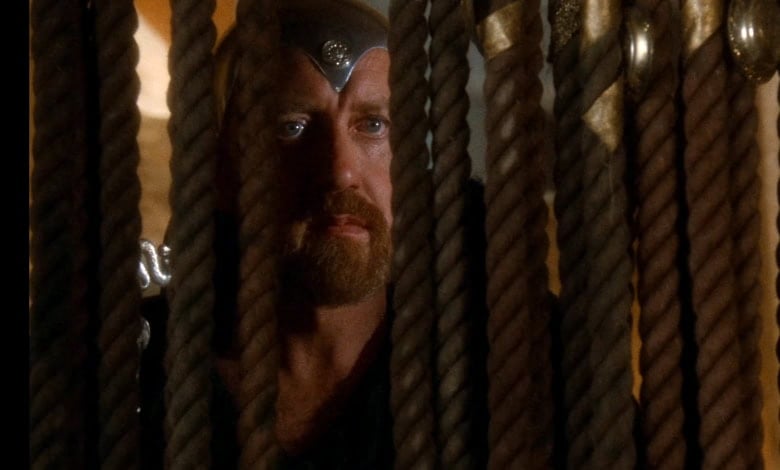
John Boorman’s “Excalibur” (1981) has gotten lost over time, as it’s neither the most recent, youth-baiting or even the clearest telling we’ve had of the King Arthur legend.
Revisiting the film today is akin to finding the sword in the stone in the woods, giving it a pull and realizing you’re clutching an imposing work of art.

Boorman’s cold, very bloody and glorious take on King Arthur and the legend of the Knights of the Round Table, is overstuffed with awesome visuals. Seeing the majestic sword Excalibur suddenly rise from the Lady of the Lake, thrust into the air by hands whose owner is unseen, is the thing of fairy tales.
Contrasting this is the tough-as-nails opener, in which the wretched Pendragon (Gabriel Byrne, in one of his first film roles), a newly appointed knight, can’t contain his lust for another man’s wife. Using the magic of Merlin (Nicol Williamson, the film’s MVP), Pendragon commits a foul act to serve his lust.
The result – a young man named Arthur (Nigel Terry) in need of a sword randomly spots one in the woods…and we’re off.
The hypnotic Williamson’s take on Merlin centers “Excalibur” as much as Boorman’s grandiose storytelling. The screenplay, written by Boorman and frequent collaborator Rospo Pallneberg, overflows with quotable dialogue.
It’s also unafraid to go very far with the use of magic as a story device. It stops just short of dragons, who are alluded to but never shown (perhaps for budgetary reasons).
I grew up loving “The Sword in the Stone” (1963) – actually, I loved the wizard’s duel portion and not the entire film. In high school, I also enjoyed Jerry Zucker’s “First Knight” (1996), despite some miscasting and a story that doesn’t kick into thrilling high gear until late into the third act.
“Excalibur,” despite a business to the screenplay that could have been made the telling a little clearer, strikes me as the best version of Arthurian legend committed to film. The reason is that Boorman gets it – this is a hearty, gory tale of ego run amok, contrasted with unlikely heroes emerging.
If reading that prior sentence made you visualize the rise of Luke Skywalker, then you clearly get Boorman’s approach.

Great uses of classical music power the soundtrack, and it’s great fun to spot Patrick Stewart, Liam Neeson, Helen Mirren (striking as Morgana) and Byrne, but the film belongs to Williamson.
“Excalibur” was Boorman’s comeback film in 1981. His reputation as an in-demand artist after making “Deliverance” (1972 and still his best movie) got seriously tainted by the quirky “Zardoz” (1974) and his infamous, scare-free and quasi-bonkers “Exorcist II: The Heretic” (1977).
Which of the two is the more unintentionally funny is a serious argument. Even now, Boorman’s tendency to embrace the unexpected and take big swings is a strong characteristic of both.
The unapologetic fantasy elements in “Excalibur” are especially better handled than the tonally off “Exorcist II.” Nevertheless, “Excalibur” does have some alienating and off-putting moments, as subtlety and suggestion aren’t among the filmmaker’s strengths.
Sometimes this is an asset, as Boorman’s especially bold, wonderful “The Emerald Forest” (1985) benefits from his embrace of the mythic; both “Excalibur” and the subsequent “The Emerald Forest” skillfully blend an adventure tale with magical realism, as well as outright magic.
FAST FACT: John Boorman admits to turning down the chance to direct both “Rocky” and “Alien” because their scripts left him cold.
Boorman’s “Excalibur” is such a splendid epic to watch, with rapturous cinematography by Alex Thomson, the genius who also shot Ridley Scott’s “Legend” (1985), Jim Henson’s “Labyrinth” (1986) and David Fincher’s “Alien 3” (1992). Seeing it on the small screen undoubtedly takes away from the scope and grandeur of Boorman’s vision.
A detail “Excalibur” made me consider, like never before, is the weight of the knight’s armor, which is vividly depicted as an obstacle as much as a means of protection.
Fans of “The Lord of the Rings” films who have never seen Boorman’s film are especially in for a treat. Both grandstanding and brutal enough to be a bit much for most mainstream audiences, “Excalibur” is a hidden gem in the filmography of a true artist.
I grew up on this movie as a teenager, but recently tried to watch the remastered 4K version at age 55 and simply couldn’t get through it.
Excalibur certainly is the best movie of the Arthurian legend. The spirituality is at the front and the film has no irony or embarrassment that it tells of faith. The visuals hold up and the acting is first rate.
This piece is a strong appreciation of *Excalibur*, highlighting how John Boorman’s film brings the Arthurian legend to life through bold visuals, heavy use of symbolism, and a dark, almost brutal tone.
It emphasizes key moments like the emergence of Excalibur, Merlin’s mysterious influence, and Arthur’s rise from an unlikely beginning. The review also contrasts the film with other versions of the legend, arguing that *Excalibur* stands out as the most powerful and complete cinematic interpretation because it focuses on human flaws, ambition, and destiny rather than just fantasy elements.
Overall, the main idea is that the film succeeds by blending myth, magic, and raw human struggle into a memorable and visually striking retelling of King Arthur’s story.
Barry, this is an excellent revisit to this brilliant cinematic retelling of the Arthurian Legends. I rewatched this not less than a month ago and once again marveled at how much detailed information was contained in the screen play. Thank you for bringing attention to this masterpiece.