
M. Night Shyamalan’s “Unbreakable” is now 25 years old.
In the opening title credits, Shyamalan finally unveiled what the movie was about, and it came as a surprise: “Unbreakable” isn’t just about comic books but the approach to comic book storytelling.

It begins in a Philadelphia department store in 1961, with a mother giving birth to a baby that initially seems fussy but is revealed to be born with broken bones. This heartbreaking prelude, revealing that the baby (heard but never seen) was born with its arms and legs broken, sets a somber tone, and the movie never looks back.
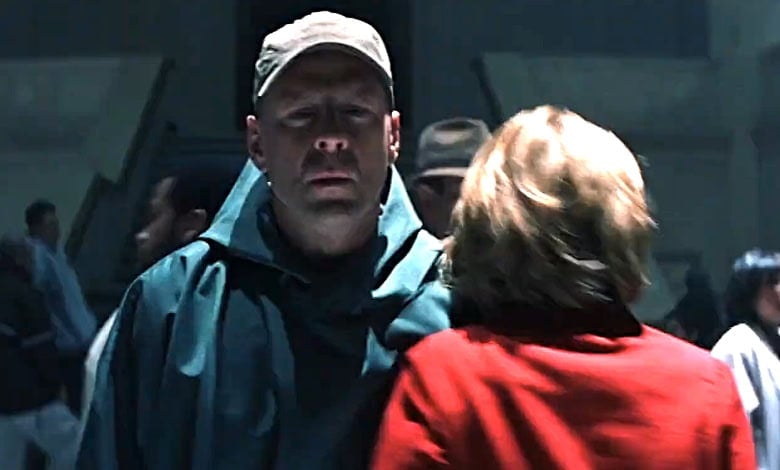
We then meet David Dunne, played by Bruce Willis, aboard a train that is moments away from becoming newsworthy; the sustained single shot that Shyamalan utilizes to introduce the character, build tension and keep us from looking away isn’t just great cinema, it prevents us from taking our eyes off the horror about to occur.
We never see the devastating train crash but only learn of it – in this film, the quasi-sequel “Split” (2016) and the true sequel “Glass” (2019), Shyamalan deconstructs the superhero genre by, among several other things, not showing us catastrophe but leaning into the impact it creates towards those who survive it.
By stripping away the spectacle, Shyamalan is going the Godard route – some will be frustrated by the elevated focus on character and lack of CGI-enhanced mayhem, let alone a more traditional approach to film storytelling. What Shyamalan is doing from the very start of “Unbreakable” isn’t just weird and unorthodox but also radical.
The sequence concludes with two more one-shot takes, one with Dunne being informed of the tragedy by the doctor and a truly spooky moment where Dunne leaves the hospital, is comforted by his family and must walk through a lobby full of those awaiting bad news. This sequence, like much of “Unbreakable,” is haunting, compassionate and so moving. Shyamalan loves his characters, and it shows right from the start.
We reconnect with Mrs. Price, the mother of the wounded baby, played by Charlayne Woodard. Price is one of the most touching mother characters I’ve ever encountered in cinema. The way she challenges her son, Elijah, who struggles with ailing health and isolation, and demonstrates her love for him by pushing him, is a thing of beauty.
The adult Elijah is played by Samuel L. Jackson. We learn he suffers from “osteogenesis imperfecta” and has had “54 breaks in his life.” Seemingly at random, Elijah, who is always in danger of having his bones once again broken, is fascinated by Dunne, who has never taken a sick day at work and might be indestructible.
The journey of Dunne and Elijah taps into universal frustrations, then and now – we’re all looking for answers and struggling to understand how we fit in this world.
FAST FACT: “Unbreakable” earned $248 million at global theaters, with $95 million coming from U.S. movie screens.
Time has been kind to this, the first Shyamalan cult movie. The only 2000 movie I liked more than this one is Sofia Coppola’s “The Virgin Suicides,” which is also a downer, deeply touching and impossible to shake off when it’s over.
As a post-modernist comic book movie, this is a master class. The defiantly somber tone and immersion into tricky, strange material announce Shyamalan as a true storyteller, not a crowd pleaser trying to match or top “The Sixth Sense” (1999), as most expected.
This is a comic book movie as an art film, take it or leave it. In 2000, most abandoned it after a big opening weekend. Today, we clearly see how it paved the way for “Heroes” (2006-2020) and more arthouse minded comic book films like Ang Lee’s “Hulk” (2003), “Watchmen” (2009) and James Gunn’s “Super” (2010), to name just a few.
I don’t entirely forgive Shyamalan for “After Earth” (2013) and still find “The Happening” (2008) laughable (and, as of 2025, I have yet to see his “The Last Airbender”). However, I’ll always give a new Shyamalan movie a shot, because he’s an all-chips-on-the-table storyteller, filmmaker and artist.
Like Christopher Nolan, Steven Spielberg, Martin Scorsese, Spike Lee and Francis Ford Coppola, Shyamalan’s work isn’t always consistent but still personal, distinct and full of interesting risks.
Whereas Shyamalan dials back the expected pyrotechnics of a comic book movie, other aspects are intriguingly applied in a near-subliminal manner: the characters are color coded (blue for Dunne, purple for Elijah), scenes are framed to resemble richly textured comic book panels and even the mise-en-scene provides texture.
Note Elijah’s great monologue about comic books: “I believe comics are our last link… to an ancient way of passing on history.” As Jackson recites the words, there’s a wall of hieroglyphics visible behind him.
When Mrs. Price hands young Elijah a 1968 issue of Action Comics and informs him that “they say this one has a surprise ending,” it’s a winking moment that references the expectations of the filmmaker and the movie we’re watching.
We share Elijah’s perspective: finding hope and truth in dark, uncertain times.
“Unbreakable” captures skewed perspectives that cause us to lean forward and adjust to the world of secrets we’re witnessing. We often see things at a distance. We’re voyeurs, discovering things by observation, not contrivance.
Few mainstream movies can succeed, let alone get away with, being this subtle.
Eduardo Serra’s cinematography is matched by the intelligence in James Newton Howard’s score, which provides two central character themes but still matches the quiet that pervades the film.
Willis is reserved, devoted to his character and allows himself to appear vulnerable as Dunne. Watch how awkwardly he flirts with that train passenger in his introductory scene- we don’t see lust but desperation. Dunne is lonely and recognizes that no one understands him.
Jackson’s fantastic performance is as showy as Willis’ is subdued, a perfect contrast. Watch Jackson closely- the edge, secrets and pain within his character are visible, if you’re looking close enough. Both actors have given bigger, more demonstrative performances but rarely have they been better than they are here.
An underrated contributor is Robin Wright, playing Audrey, Dunne’s wife. Wright is heartbreaking and elevates a potentially thankless character. Audrey’s late-night confession to Dunne and her two scenes with Elijah are beautifully played.
25th Anniversary: UNBREAKABLE (2000) M. Night Shyamalan pic.twitter.com/8BC4T86eGa
— Cinema Phenomenology (@phenocine) November 14, 2025
Playing Dunne’s son, Joseph, Spencer Treat Clark is key to the success of the film’s riskiest scene; Joseph tries to prove his father is who he thinks he is, in a dangerous way, over the breakfast table. It’s an uncomfortable moment, and Shyamalan is on dangerous ground here.
It’s the scene that Shyamalan probably should have cut. As is, it gives the film a real edge.
Likewise is the savagery of the villain Dunne pursues in the climax, a sequence as scary as the most jolting moments in “The Sixth Sense.”
The two closing scenes, in which father and son and Dunne and Elijah fully understand each other, are golden. In the former, the lack of words exchanged is instead a look of understanding between two men who finally understand each other.
In the latter, it’s a similar but heartbreaking realization that, in addition to how figuratively and literally broken Elijah is, we somehow missed how dangerous he is.
“The Sixth Sense” and “Split” may wind up Shyamalan’s most popular works, but “Unbreakable” is still his absolute best.