
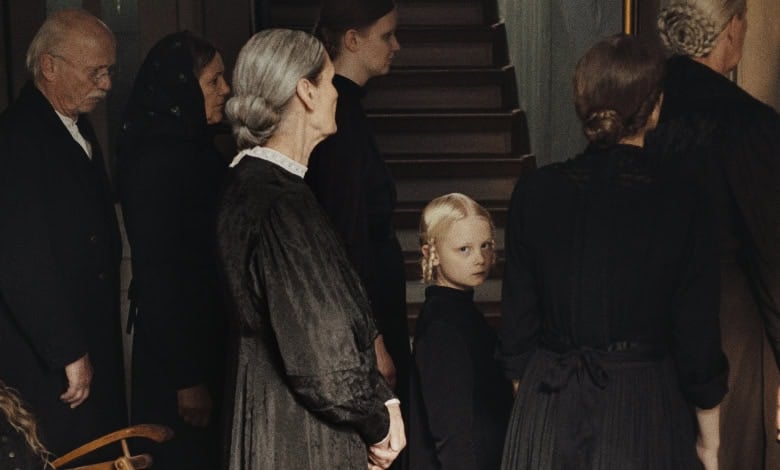
Sometimes watching a movie is like seeing someone’s dreams, a hypnotic experience where we get to witness the obsessions and fantasies of an artist.
At other times, watching a movie can be like listening to someone describe their dreams, which can be dreary and patience testing. Mascha Schilinski’s “Sound of Falling” begins like the former but becomes the latter.
This love-it-or-hate-it drama, an acclaimed favorite on the film festival circuit and probable Oscar contender, has it followers. I was completely on board with Schilinski’s vision at first, until I got to the point where I couldn’t defend it and just wanted it to end.
“Sound of Falling” is a highly stylized German film, showing us a family that has lived in a home a century ago, lingering on their daily lives and unguarded moments. Then the story jumps to a generation later, with the family living during World War II, then during the 1980s, then in more contemporary times.
Sometimes we see this family in a different setting but most of the film centers around the property that opened the film and lingers on the moments that are private and unflattering.
Comparisons to the films of Ingmar Bergman are merited, as the pace, tone and visuals reminded me of some of his darker, more contemplative films.
Yet, to go with a more crassly mainstream comparison, “Sound of Falling” is exactly what Robert Zemeckis’ “Here” (2024) was trying to be. In both films, the camera is the eye, as we are the invisible visitors/observers watching different generations of people inhabiting a single space over periods of time.
Schilinski’s eerie film is like “Fanny and Alexander” (1982) crossed with the darkest detours from David Lynch or Lynne Ramsay. In fact, the entire first act reminded me of Lynch’s “Eraserhead” (1977). I mean this as a compliment. and this portion of the film had me bewitched and optimistic.

In some scenes, characters are seen gazing directly into the camera, right at us, a truly unsettling feeling. The editing will take jumps into the near future, showing us a character we’re currently watching, then revealing the moment of their death, then cutting back to where we left off.
Then the story cuts to a more recent time in human history, but the feeling of being a voyeur never ceases. Sometimes, we watch what seem like random moments. At other times, the characters take focus and become vivid and relatable.
Like the best films of Lynch, it fluctuates wildly between resembling a gorgeous painting or a dread-inducing waking nightmare.
“Sound of Falling” turns uncomfortably intimate and difficult after an hour, becoming hard to endure, let alone remain invested in. My admiration remains for the artistry, but the film becomes unbearable.
At 155 minutes, the endless loop of discomfiting, often perverse imagery wore me down. There is true film artistry here and the film will stay with you but whether you want to experience something this taxing in full is up to the viewer. David Lynch came up a lot in my critique, reminding me how much I miss him but also how much heart and humanity exists in his work, even at his coal-black darkest.
“Sound of Falling” needed to be more like Lynch, with his tendency to linger on lost innocence, and less like invisible, unholy surveillance footage. Schilinski is a major talent, and I’m looking forward to whatever she does next, but I won’t ever watch “Sound of Falling” again.
Two Stars (out of four)