
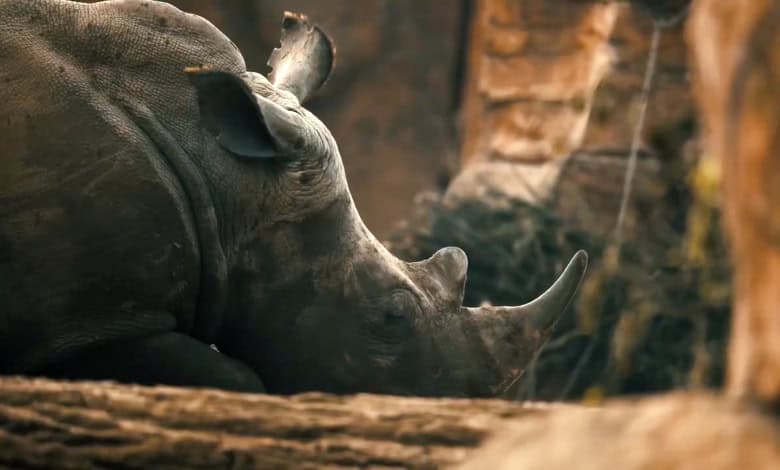
What price the horn? A question for the ages, but an urgent one for the white rhinoceros.
Poached to near-extinction for our turn on and tincture, these magnificent beasts are clinging on to Mother Earth by their gloriously thick toenails, as depicted here with great clarity and anger by director Juliette Marquis in “Horn Maker.”
Her documentary reveals a radical scheme to sink the abominable trade in rhino horn.

She starts with a heart-melting encounter at a white rhino sanctuary, with orphaned baby rhino calves gathering around, mewing like kittens. “Walking fortresses with the voices of sopranos,” she marvels as they overwhelm us.
This is a great opener, reinforced with some simple statistics about the fall and rise and fall again of these animals. Marquis claims the lust for powdered horn in “medicine” and cosmetics makes it “more valuable per gram than cocaine or gold” (but it is actually halfway between the two).
Regardless, the murder of these marvels runs at shocking rates in Southern Africa, where they still barely remain. They don’t poach the Northern African White Rhino anymore. There are two left, under guard, both female.
The blasphemy of it all is hard to take in. And when Marquis decides she will go undercover to expose the Mozambique gangs poaching neighboring Kruger national park, we are cheering her on. That’s despite the fact that a fine-boned, fluffy-haired person like her seems the worst possible candidate for investigating brutal African gangs who live in the shadows and deal in death.
And, as much as we would like a feature film about a Rambo dog mom fumigating these ghouls in their own armpit, seeing Marquis try it for real seems a worrying prospect. We watch her in a nifty training montage featuring firearms and unarmed combat.
Thankfully, we then get perhaps the mother of all needle scratches and F*** THAT I’M OUTs as her evident love for these mighty beasts leads her to discover the true subject of this sparkling little gem of a film.
Matthew Markus, the shy and passionate co-founder of tech start-up Pembient, is on a mission to destroy the market with his 3D-printed bio-horn (he should share the bill with “Dog Mom Safari Massacre”).

Markus’s proposal is that the simple structure of the rhino horn can be replicated in a lab using the latest 3D printing technologies. That would cause the scarcity to disappear, thus lowering the incentive to poach.
He and Marquis get quite deep into the trade they are investigating. In one memorable scene, they are given a peek at a Vietnamese lock-up stuffed full of just one months worth of ivory and horn ready to be worked decoratively.
These investigations are fearless stuff, so Marquis’s continued delicacy in not interrogating the innards of Pembient, as if she’s convinced herself there may be something rotten at the core, or just doesn’t know how to ask them, as an otherwise superb film’s Achilles’ heel.
As it stands, we never get a clear indication of whether the scheme was remotely credible.
“Horn Maker” gets a lot right, but there is a free-wheeling nature to the documentary, like it barely has its head above water. Nonetheless this is a brief, entertaining, although perhaps slightly illusive fable about tech startups, the literal Heart of Darkness of poaching, and what seems like a modern NGO Industrial Complex.
Also, and to her incredible credit, Marquis does get up close and personal, interviewing the terrifying-looking gangs killing the rhinos.
“Two rhino calves born at The Wilds, one a world first outside Africa” #Ohio (The Columbus Dispatch) on SmartNews: https://t.co/FuQEobP34a #SmartNews
— hardknoxfirst 🇺🇦 (@hardknoxfirst) November 23, 2026
The finale of this doc is as strong as the opening, and it takes some stomaching. When Markus attends a USAID buoyed trade fair for NGOs (all the way back in 2018, but this released in 2026) to promote his market-busting initiative, he is non-platformed and then savaged by the conservation charities at a desperate side-bar he stages.
He seems like a nice guy with a pretty radical scheme, trying to canvas effective feedback from the experts responsible for the lions share of the conservation effort, but he is sneered out of the room as if by hyaenas, with most of the scalding criticism of him seeming steamy and uncertain in itself.
Regardless, the next time we see him, a year later, he has wild eyes and a beard and no further stake or interest in the struggle against poaching. All the more reason for us to have been given a handle on how real he and his tech were, something which is let go here with nary a whisper of inquiry.
Anyway, the famed traveller Paul Theroux pointed out in one of his books that during all his many journeys in Africa, the only people who invariably failed to offer a lift were the NGOs. Make of that what you will.
Conservation efforts seemed to work for a while, but the rhinos are heading for extinction again.
Perry Norton is a film writer and cyber security consultant currently based in East London. Follow him on X at @perrynorton.