
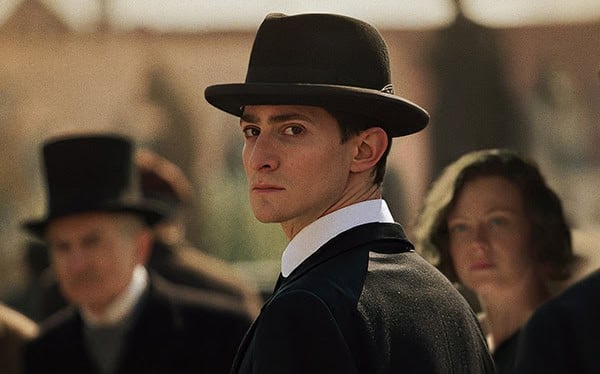
Agnieszka Holland’s “Franz” is a frustrating experience, and not merely because it’s about the life of writer Franz Kafka, whose work reflected universal frustrations and fears.
By adapting Marek Epstein’s screenplay, which tells the story of Kafka’s journey as a writer from his troubled home life into his later years, the film is fragmented in ways that are unique but ultimately distancing.

As a boy, Kafka is played by Daniel Dongres, but most of the film has the role embodied by Idan Weiss. Both actors are uncanny in their resemblance to the great writer.
Weiss’ expressive, surprising upbeat performance centers the film, as we watch Kafka’s struggles in early 20th century Prague to get his challenging literary works accepted.
With a war looming and Kafka’s father (by far the film’s most vivid character, powerfully depicted by Peter Kurth) unsupportive of his son, we witness Kafka’s evolving confidence in his words, love life and willingness to gain control of his life. The moment where Kafka announces to his family that he’s breaking off his engagement, with his unhappy fiancée sitting next to him, is an especially striking moment.
The production is polished, and “Franz” is always interesting but consistently off-putting. Around the 20-minute mark, there’s a sequence where we see the contents of an early Kafka story depicted, in which a faulty torture machine is administered, while the author reads to a disgusted audience.
The scene is as gross as anything you’d find in a “Saw” sequel.
Combine this sequence with ample shots of graphic nudity and close-ups of bloody beef and surgical procedures, and you have a movie that will make anyone abandon their popcorn early on.

Here’s where the film kept losing me: the onscreen figures often break character and look straight into the camera, providing historical tidbits and exposition into Kafka’s life. Then, the real doozy is that Holland frequently intersperses contemporary scenes of tourists visiting the Kafka Museum, noting his awesome rotating stature outside, then getting a “Kafka Burger” next door.
The juxtapositions are jarring, as we’re in the 1900s one minute, then hearing a tour guide explain the contents within the modern-day Kafka Museum.
Even for a movie about Kafka, this is weird.
Weiss’ performance pulled me in, as I’m used to seeing Kafka portrayed as an eerie presence in suits but never as the smiling, romantic figure we get here. Considering that the film was (per the end credits) made with the participation of Kafka’s family and authorities on the subject, I wanted to embrace what Holland has pulled off.
The cinematography by Tomasz Naumiuk alternates between beautifully framed moments with jittery filming and lots of dramatic zooms. I was willing to overlook this and the David Lynch-like inserts of Kafka screaming and diving into water that bridge a few moments, as well as the kaleidoscopic shots of his face (perhaps reflecting on his various identities as author, lover, son and visionary).
All the self-consciously artsy touches are forgiven, as, I suspect Kafka himself would have enjoyed inventive visual approaches to the story of his life. However, whenever the focus cuts back to the tour group gazing at Kafka artifacts while the guide drones on, I felt like the guy strapped into Kafka’s torture machine.
I love Holland’s work and have been a fan after seeing her take on “The Secret Garden” (1993). While “Europa Europa” (1990) and “In Darkness” (2011) are among her most justly celebrated, I’d also recommend the highly underrated Ed Harris-led drama, “The Third Miracle” (1999).

It can be argued that the historical reenactments countered with modern day commentary are efforts to be definitive, but, if so, why don’t we get scenes from Kafka’s “The Metamorphosis,” “The Trial” or “The Castle”? All three come up by name or thematically but seeing them depicted, even in short form, would have been welcome.
Watching “Franz” made me badly want to revisit Steven Soderbergh’s great “Kafka” (1992), which stars Jeremy Irons and has been out of print for over a decade. Soderbergh’s film, his second after “Sex, Lies and Videotape” (1989), isn’t a Kafka bio but a thriller taking place within the world of Kafka’s literature.
It might be my favorite movie that tackles the author, though the Kyle MacLachlan/ Anthony Hopkins-led take on “The Trial” (1993) is another underestimated adaptation. Watching “Franz” inspired me to re-read Kathi Diamant’s “Kafka’s Last Love,” her engrossing 2003 book about the relationship Kafka shared with Dora Diamant at the end of his life.
For all the efforts here to make a definitive film on the life and works of Kafka, Holland’s “Franz” feels half-there.
Two Stars (out of four)