
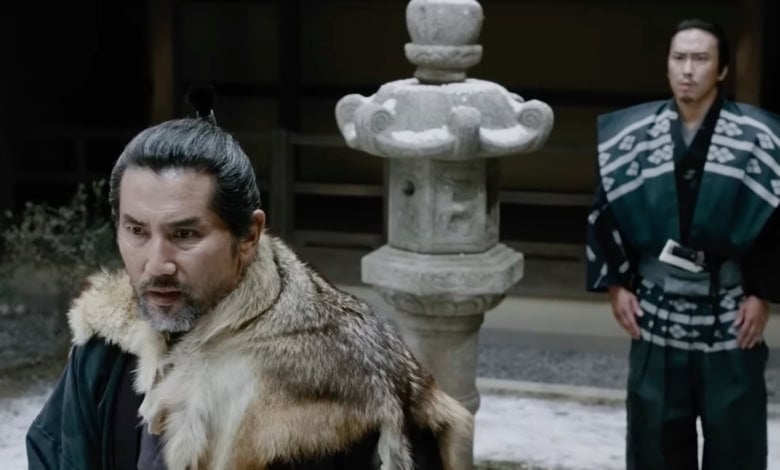
The first thing to know about writer/director Kiyoshi Kurosawa’s “The Samurai and the Prisoner” is that the filmmaker is not related to the late, great cinema master Akira Kurosawa (1910-1998).
Yet, Kiyoshi Kurosawa’s film has visual and thematic similarities to Akira Kurosawa’s “The Hidden Fortress” (1958), as well as a little of “Throne of Blood” (1957) and a dash of “Rashomon” (1950). That places it in tremendous company, but it’s also a strong, enticing film on its own.

Set in 1578 Japan, we watch as a conversation between Lord Murashige (an imposing Masahiro Motoki) and Kanbei (Masaki Suda) leads to a discovery of deception, as Kanbei is imprisoned and Murashige struggles in his ongoing battle against the warlord Oda.
When a prisoner named Jinen is found dead under mysterious circumstances, an investigation takes place and many possible suspects surface. Murashige turns to Kanbei, still under confinement, for help in unraveling the mystery while the battle rages outside the confines of the fortress.
The introductory scenes are overloaded with exposition, but once the central mystery is established, this becomes a patient, engaging drama. It’s not simply the marvelous sets and costumes – the performances pull us in and are crucial to the film’s success.
In the lead, Motoki is wonderful, evoking the kind of authoritative presence that reminded me of no less than Toshiro Mifune. Suda gives a vivid, layered performance as the imprisoned Kanbei and so does Yuriko Yoshitaka as Murashige’s wife.
I will never forget the scenes where Murashige and his men must inspect the decapitated heads of their enemies in their search for truth.

The characters question spiritual matters, as the conversations often turn towards proof of the divine in the midst of bloodshed. A line that appears at the midpoint: “What is the world coming to? Nothing makes sense anymore.” It’s similar to the inciting lines of “Rashomon.” Another worthwhile question that arises: “Can a war be won without killing?”
The best scenes take place in the dungeon, as Murashige and Kanbei build an unlikely alliance and cautiously learn to trust one another. As captor and prisoner collaborate in searching for the identity of the killer, they discover how tricky the truth of the matter is, as the killer, once revealed, is unexpected.
The two closing scenes are as dramatically rich and surprising as one would hope.
“The Samurai and the Prisoner” isn’t an action movie, as most of the violence occurs off screen and the film is both dialogue and character-driven. The plot is complex, and the conversations are almost non-stop, meaning this may be hard for those reading subtitles.
Even at 147 minutes, this period drama and whodunit is worth the viewer’s investment, whether you’re a fan of classic Kurosawa films or just love an unorthodox mystery.
Full of beautiful character moments, gliding cinematography and a worthwhile puzzle for viewers who pay close attention, it’s one of those long films that requires the audience to be attentive but rewards them, not only in the outcome but with the richness in the setup that comes with repeat viewings.
“The Samurai and the Prisoner” premiered at this year’s Cannes Film Festival and is already a blockbuster in Japan. I’ve been excited to see it since I first read about it and am happy to report that it was worth the wait.
Some costume dramas can feel like safe, seen-it-before pageantry, but not this one.
Three and a half stars (out of four)