
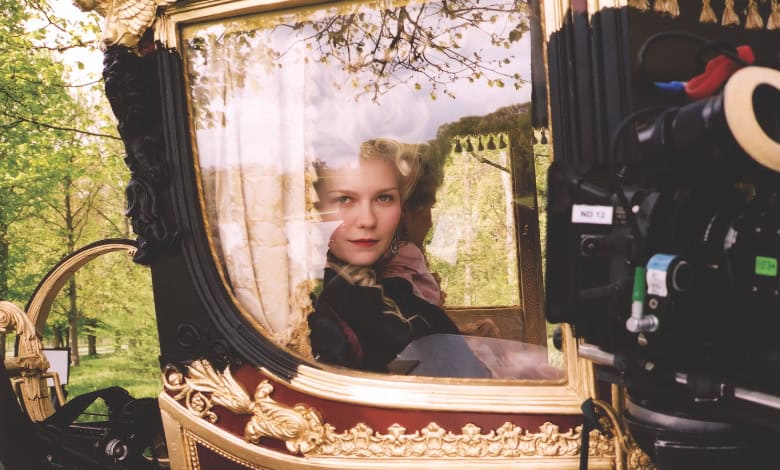
Sofia Coppola’s “Marie Antoinette” (2006) was seen as a self-indulgent misstep upon release, but time has been kind to the film.
To put it another way, a movie I liked but didn’t connect with 20 years ago now feels as fresh, radical and spellbinding as it always was.

The set-up is the history lesson as we remember it: in 1770, Marie (Kirsten Dunst) is the Austrian Archduchess who is sent to France, where she is arranged to marry the Louis-Auguste (Jason Schwartzman) and create an Austrian/French alliance.
In addition to abandoning her life as she knew it, Marie is forced to give up her pet, which she asks about later but is never given a solid answer about. It’s a small thing, but Coppola found a way to make Marie relatable.
As Marie slowly becomes accustomed to waking up to a group of attentive servants and a full schedule, her dedication as Louie’s wife goes from resembling an ornate prison sentence to something genuine. In the same way, Marie’s engagement as a political figure goes from daily self-indulgences to becoming involved with the fate of her country.
Coppola’s film has visual precision and aims for the perfection of historical pageantry of Stanley Kubrick’s “Barry Lyndon” (1975). The biggest distinction of why Coppola’s film is so different from Kubrick’s is that she doesn’t try for a definitive take on the topic.
Instead, the playful, intuitive performances are among the many touches that lead it in experimental directions.
I loved the film’s famous teaser trailer, with dialogue-free snippets of clips set to New Order’s “Age of Consent.” I wasn’t ready in 2006 for Coppola’s feature-length extension of that premise, with 1980s pop tunes present in much of the film.
The story may take place in France, but every character speaks like they’re from California.

Let’s get this out of the way: there are other films, books and mini-series that tell this story better, aim for stronger historical accuracy and want to provide a close facsimile of what happened. Coppola’s film, despite its opulence and ample examples of pure cinema, is akin to a personal expression and twist on convention.
The scenes of drama feel less rehearsed than simply found. In other words, this is a film by Sofia Coppola.
Almost all the dialogue is in English, and Coppola offers a complex and sympathetic view of its subject matter, as well as a French New Wave approach to conventional film storytelling. It’s no wonder it bombed so hard at the Cannes Film Festival.
“Marie Antoinette” is astonishing not only for its physical beauty but for how alive and spontaneous it feels on a scene-to-scene basis, aligning itself thematically and visually with Coppola’s prior films. Visually, “Marie Antoinette” couldn’t be more different from the rest of Coppola’s body of work, but it is cut from the same cloth as her subsequent “The Bling Ring” (2013) and “The Beguiled” (2017).

In 2006, I wondered if the film, a depiction of a young woman obtaining power and notoriety, then asserting herself in world culture, was really about Paris Hilton. Today, it’s Coppola offering a celebratory and critical view of Marie’s wall of wealth, privilege and abuse of power.
Yet, it’s all delivered without a heavy hand or a spell-it-all-out monologue.
It’s Dunst’s film, and she is spectacular in this, giving a generous performance that finds unexpected shades of vulnerability and strength. It reminded me of her work in Coppola’s first and still best film, “The Virgin Suicides” (2000).
Schwartzman’s vulnerable performance is among the many great supporting turns that needs to be rediscovered. Time will tell how Sofia Coppola’s body of work stacks against her legendary father’s filmography, but the truth is that it doesn’t matter.
The two directors couldn’t be more unlike.
“Marie Antoinette” seemed like Sofia Coppola was heading into a shaky “One from the Heart” (1982) or “Rumble Fish” (1983) era but, just as proper appreciation for those films has allowed a newfound perspective, Coppola’s costume drama emerges anew as one of its year’s most visually sumptuous and rewarding dramas.
The new Criterion Collection release is fully deserved and a welcome addition.
While “Marie Antoinette” came back to theaters last month with a 4K upgrade and revival screenings, we also got Eleanor Coppola’s “Making Marie Antoinette.” The documentary is among the last projects from Sofia’s late mother.

Eleanor, let it be firmly stated, made “Hearts of Darkness: A Filmmaker’s Apocalypse” (1991), the greatest making-of-a-movie documentary. The film shared the disaster-plagued production of her husband Francis Ford Coppola’s “Apocalypse Now.”
The fly-on-wall, I-can’t-believe-we’re-seeing-this, you-are-there feel of Eleanor Coppola’s film allowed for a greater appreciation and understanding of her husband’s directorial brilliance and the film itself. Considering how Eleanor is at the helm of “Making Marie Antoinette,” there’s undeniable pressure for it to emerge as strongly as her prior work, and it never happens.
Not only is “Marie Antoinette” a smaller film, but the struggles Sofia visibly experiences seem neither here nor there, as the drama that emerges during filming ranges from personal insecurity to retroactively missing the experience on the last day of filming.
It is essential that fans of the Coppola family and “Marie Antoinette” only watch “Making Marie Antoinette” after watching “Marie Antoinette.”
Both are worth seeing. The documentary is engaging but slight, whereas “Marie Antoinette” is a masterpiece.
(Photo Credit: Sofia Coppola)